

Parenting/Child Development Series – 6-8 yrs

Middle Childhood (6-8 years of age)
Developmental Milestones
Middle childhood brings many changes in a child’s life. By this time, children can dress themselves, catch a ball more easily using only their hands, and tie their shoes. Having independence from family becomes more important now. Events such as starting school bring children this age into regular contact with the larger world. Friendships become more and more important. Physical, social, and mental skills develop quickly at this time. This is a critical time for children to develop confidence in all areas of life, such as through friends, schoolwork, and sports.

Here is some information on how children develop during middle childhood:

Emotional/Social Changes
Children in this age group might:

  • Show more independence from parents and family.
  • Start to think about the future
  • Understand more about his or her place in the world.
  • Pay more attention to friendships and teamwork.
  • Want to be liked and accepted by friends.

Thinking and Learning

  • Children in this age group might.
  • Show rapid development of mental skills.
  • Learn better ways to describe experiences and talk about thoughts and feelings.
  • Have less focus on one’s self and more concern for others.

Positive Parenting Tips
Following are some things you, as a parent, can do to help your child during this time:

  • Show affection for your child. Recognize her accomplishments.
  • Help your child develop a sense of responsibility—ask him to help with household tasks, such as setting the table.
  • Talk with your child about school, friends, and things she looks forward to in the future.
  • Talk with your child about respecting others. Encourage him to help people in need.
  • Help your child set her own achievable goals—she’ll learn to take pride in herself and rely less on approval or reward from others.
  • Help your child learn patience by letting others go first or by finishing a task before going out to play. Encourage him to think about possible consequences before acting.
  • Make clear rules and stick to them, such as how long your child can watch TV or when she has to go to bed. Be clear about what behavior is okay and what is not okay.\
  • Do fun things together as a family, such as playing games, reading, and going to events in your community. Positive Parenting Tips for Healthy Child Development
  • Get involved with your child’s school. Meet the teachers and staff and get to understand their learning goals and how you and the school can work together to help your child do well.
  • Continue reading to your child. As your child learns to read, take turns reading to each other.
  • Use discipline to guide and protect your child, rather than punishment to make him feel bad about himself. Follow up any discussion about what not to do with a discussion of what to do instead.
  • Praise your child for good behavior. It’s best to focus praise more on what your child does (“you worked hard to figure this out”) than on traits she can’t change (“you are smart”).
  • Support your child in taking on new challenges. Encourage her to solve problems, such as a disagreement with another child, on her own.
  • Encourage your child to join school and community groups, such as a team sports, or to take advantage of volunteer opportunities.

Child Safety First
More physical ability and more independence can put children at risk for injuries from falls and other accidents. Motor vehicle crashes are the most common cause of death from unintentional injury among children this age.

  • Protect your child properly in the car. For detailed information, see the American Academy of Pediatrics’ Car Safety Seats: A Guide for Families.
  • Teach your child to watch out for traffic and how to be safe when walking to school, riding a bike, and playing outside.
  • Make sure your child understands water safety, and always supervise her when she’s swimming or playing near water.
  • Supervise your child when he’s engaged in risky activities, such as climbing.
  • Talk with your child about how to ask for help when she needs it.
  • Keep potentially harmful household products, tools, equipment, and firearms out of your child’s reach.

Healthy Bodies

  • Parents can help make schools healthier. Work with your child’s school to limit access to foods and drinks with added sugar, solid fat, and salt that can be purchased outside the school lunch program.
  • Make sure your child has 1 hour or more of physical activity each day.
  • Limit screen time for your child to no more than 1 to 2 hours per day of quality programming, at home, school, or afterschool care.
  • Practice healthy eating habits and physical activity early. Encourage active play, and be a role model by eating healthy at family mealtimes and having an active lifestyle.

A pdf of this document for reprinting is available free of charge from
http://www.cdc.gov/ncbddd/childdevelopment/positiveparenting/middle.html

Additional Information:
http://www.cdc.gov/childdevelopment
1-800-CDC-INFO (800-232-4636) http://www.cdc.gov/info


    Request a Complementary Consultation

    Parenting/Child Development Series – 9-11 yrs

    Middle Childhood (9-11 years of age)

    Developmental Milestones
    Your child’s growing independence from the family and interest in friends might be obvious by now. Healthy friendships are very important to your child’s development, but peer pressure can become strong during this time. Children who feel good about themselves are more able to resist negative peer pressure and make better choices for themselves. This is an important time for children to gain a sense of responsibility along with their growing independence. Also, physical changes of puberty might be showing by now, especially for girls. Another big change children need to prepare for during this time is starting middle or junior high school.

    Here is some information on how children develop during middle childhood:

    Emotional/Social Changes
    Children in this age group might:

    • Start to form stronger, more complex friendships and peer relationships. It becomes more emotionally important to have friends, especially of the same sex.
    • Experience more peer pressure.
    • Become more aware of his or her body as puberty approaches. Body image and eating problems sometimes start around this age.

    Thinking and Learning
    Children in this age group might:

    • Face more academic challenges at school.
    • Become more independent from the family.
    • Begin to see the point of view of others more clearly.
    • Have an increased attention span.

    Positive Parenting Tips
    Following are some things you, as a parent, can do to help your child during this time:

    • Spend time with your child. Talk with her about her friends, her accomplishments, and what challenges she will face.
    • Be involved with your child’s school. Go to school events; meet your child’s teachers.
    • Encourage your child to join school and community groups, such as a sports team, or to be a volunteer for a charity.
    • Help your child develop his own sense of right and wrong. Talk with him about risky things friends might pressure him to do, like smoking or dangerous physical dares.
    • Help your child develop a sense of responsibility—involve your child in household tasks like cleaning and cooking. Talk with your child about saving and spending money wisely.
    • Meet the families of your child’s friends.
    • Talk with your child about respecting others. Encourage her to help people in need. Talk with her about what to do when others are not kind or are disrespectful. Positive Parenting Tips for Healthy Child Development
    • Help your child set his own goals. Encourage him to think about skills and abilities he would like to have and about how to develop them.
    • Make clear rules and stick to them. Talk with your child about what you expect from her (behavior) when no adults are present. If you provide reasons for rules, it will help her to know what to do in most situations.
    • Use discipline to guide and protect your child, instead of punishment to make him feel badly about himself.
    • When using praise, help your child think about her own accomplishments. Saying “you must be proud of yourself” rather than simply “I’m proud of you” can encourage your child to make good choices when nobody is around to praise her.
    • Talk with your child about the normal physical and emotional changes of puberty.
    • Encourage your child to read every day. Talk with him about his homework.
    • Be affectionate and honest with your child, and do things together as a family.

    Child Safety First
    More independence and less adult supervision can put children at risk for injuries from falls and other accidents. Here
    are a few tips to help protect your child:

    • Protect your child in the car. The National Highway Traffic Safety Administration recommends that you keep your child in a booster seat until he is big enough to fit in a seat belt properly. Remember: your child should still ride in the back seat until he or she is 12 years of age because it’s safer there. Motor vehicle crashes are the most common cause of death from unintentional injury among children of this age.
    • Know where your child is and whether a responsible adult is present. Make plans with your child for when he will call you, where you can find him, and what time you expect him home.
    • Make sure your child wears a helmet when riding a bike or a skateboard or using inline skates; riding on a motorcycle, snowmobile, or all-terrain vehicle; or playing contact sports.
    • Many children get home from school before their parents get home from work. It is important to have clear rules and plans for your child when she is home alone.

    Healthy Bodies

    • Provide plenty of fruits and vegetables; limit foods high in solid fats, added sugars, or salt, and prepare healthier foods for family meals.
    • Keep television sets out of your child’s bedroom. Limit screen time, including computers and video games, to no more than 1 to 2 hours.
    • Encourage your child to participate in an hour a day of physical activities that are age appropriate and enjoyable and that offer variety! Just make sure your child is doing three types of activity: aerobic activity like running, muscle strengthening like climbing, and bone strengthening – like jumping rope – at least three days per week.

    A pdf of this document for reprinting is available free of charge from
    http://www.cdc.gov/ncbddd/childdevelopment/positiveparenting/middle2.html
    Additional Information:
    http://www.cdc.gov/childdevelopment
    1-800-CDC-INFO (800-232-4636) http://www.cdc.gov/inf

      Request a Complementary Consultation

      Parenting/Child Development Series – 12-14 yrs

      Young Teens (12-14 years of age)
      Developmental Milestones

      This is a time of many physical, mental, emotional, and social changes. Hormones change as puberty begins. Most boys
      grow facial and pubic hair and their voices deepen. Most girls grow pubic hair and breasts, and start their period. They
      might be worried about these changes and how they are looked at by others. This also will be a time when your teen
      might face peer pressure to use alcohol, tobacco products, and drugs, and to have sex. Other challenges can be eating
      disorders, depression, and family problems. At this age, teens make more of their own choices about friends, sports,
      studying, and school. They become more independent, with their own personality and interests, although parents are
      still very important.
      Here is some information on how young teens develop:

      Emotional/Social Changes
      Children in this age group might:

      • Show more concern about body image, looks, and clothes.
      • Focus on themselves; going back and forth between high expectations and lack of confidence.
      • Experience more moodiness.
      • Show more interest in and influence by peer group.
      • Express less affection toward parents; sometimes might seem rude or short-tempered.
      • Feel stress from more challenging school work.
      • Develop eating problems.
      • Feel a lot of sadness or depression, which can lead to poor grades at school, alcohol or drug use, unsafe sex, and other problems.

      Thinking and Learning
      Children in this age group might:

      • Have more ability for complex thought.
      • Be better able to express feelings through talking.
      • Develop a stronger sense of right and wrong.

      Positive Parenting Tips
      Following are some things you, as a parent, can do to help your child during this time:

      • Be honest and direct with your teen when talking about sensitive subjects such as drugs, drinking, smoking, and sex.
      • Meet and get to know your teen’s friends.\
      • Show an interest in your teen’s school life.
      • Help your teen make healthy choices while encouraging him to make his own decisions.
      • Respect your teen’s opinions and take into account her thoughts and feelings. It is important that she knows you are listening to her.
      • When there is a conflict, be clear about goals and expectations (like getting good grades, keeping things clean, and showing respect), but allow your teen input on how to reach those goals (like when and how to study or clean).

      Child Safety First
      You play an important role in keeping your child safe―no matter how old he or she is. Here are a few tips to help
      protect your child:

      • Make sure your teen knows about the importance of wearing seatbelts. Motor vehicle crashes are the leading cause of death among 12- to 14-year-olds.
      • Encourage your teen to wear a helmet when riding a bike or a skateboard or using inline skates; riding on a motorcycle, snowmobile, or all-terrain vehicle; or playing contact sports. Injuries from sports and other activities are common.
      • Talk with your teen about the dangers of drugs, drinking, smoking, and risky sexual activity. Ask him what he knows and thinks about these issues, and share your thoughts and feelings with him. Listen to what she says and answer her questions honestly and directly.
      • Talk with your teen about the importance of having friends who are interested in positive activities. Encourage her to avoid peers who pressure her to make unhealthy choices.
      • Know where your teen is and whether an adult is present. Make plans with him for when he will call you, where you can find him, and what time you expect him home.
      • Set clear rules for your teen when she is home alone. Talk about such issues as having friends at the house, how to handle situations that can be dangerous (emergencies, fire, drugs, sex, etc.), and completing homework or household tasks.

      Healthy Bodies

      • Encourage your teen to be physically active. She might join a team sport or take up an individual sport. Helping with household tasks such as mowing the lawn, walking the dog, or washing the car also will keep your teen active.
      • Meal time is very important for families. Eating together helps teens make better choices about the foods they eat, promotes healthy weight, and gives your family members time to talk with each other.
      • Limit screen time for your child to no more than 1 to 2 hours per day of quality programming, at home, school, or afterschool care.

      A pdf of this document for reprinting is available free of charge from
      http://www.cdc.gov/ncbddd/childdevelopment/positiveparenting/adolescence.html

      Additional Information:
      http://www.cdc.gov/childdevelopment
      1-800-CDC-INFO (800-232-4636) http://www.cdc.gov/info

        Request a Complementary Consultation

        Parenting/Child Development Series – 15-17 yrs

        Teenagers (15-17 years of age)
        Developmental Milestones
        This is a time of changes for how teenagers think, feel, and interact with others, and how their bodies grow. Most girls will be physically mature by now, and most will have completed puberty. Boys might still be maturing physically during this time. Your teen might have concerns about her body size, shape, or weight. Eating disorders also can be common, especially among girls. During this time, your teen is developing his unique personality and opinions. Relationships with friends are still important, yet your teen will have other interests as he develops a more clear sense of who he is. This is also an important time to prepare for more independence and responsibility; many teenagers start working, and many will be leaving home soon after high school.

        Here is some information on how teens develop:

        Emotional/Social Changes
        Children in this age group might:

        • Have more interest in romantic relationships and sexuality.
        • Go through less conflict with parents.
        • Show more independence from parents.
        • Have a deeper capacity for caring and sharing and for developing more intimate relationships.
        • Spend less time with parents and more time with friends.
        • Feel a lot of sadness or depression, which can lead to poor grades at school, alcohol or drug use, unsafe sex, and other problems.

        Thinking and Learning
        Children in this age group might:

        • Learn more defined work habits.
        • Show more concern about future school and work plans.
        • Be better able to give reasons for their own choices, including about what is right or wrong.


        Positive Parenting Tips
        Following are some things you, as a parent, can do to help your teen during this time:

        • Talk with your teen about her concerns and pay attention to any changes in her behavior. Ask her if she has had suicidal thoughts, particularly if she seems sad or depressed. Asking about suicidal thoughts will not cause her to have these thoughts, but it will let her know that you care about how she feels. Seek professional help if necessary.
        • Show interest in your teen’s school and extracurricular interests and activities and encourage him to become involved in activities such as sports, music, theater, and art.
        • Encourage your teen to volunteer and become involved in civic activities in her community.
        • Compliment your teen and celebrate his efforts and accomplishments.
        • Show affection for your teen. Spend time together doing things you enjoy.
        • Respect your teen’s opinion. Listen to her without playing down her concerns.
        • Encourage your teen to develop solutions to problems or conflicts. Help your teenager learn to make good decisions. Create opportunities for him to use his own judgment, and be available for advice and support.
        • If your teen engages in interactive internet media such as games, chat rooms, and instant messaging, encourage her to make good decisions about what she posts and the amount of time she spends on these activities.
        • If your teen works, use the opportunity to talk about expectations, responsibilities, and other ways of behaving respectfully in a public setting.
        • Talk with your teen and help him plan ahead for difficult or uncomfortable situations. Discuss what he can do if he is in a group and someone is using drugs or under pressure to have sex, or is offered a ride by someone who has been drinking.
        • Respect your teen’s need for privacy.
        • Encourage your teen to get enough sleep and exercise, and to eat healthy, balanced meals.
        • Encourage your teen to have meals with the family. Eating together will help your teen make better choices about the foods she eats, promote healthy weight, and give family members time to talk with each other. In addition, a teen who eats meals with the family is more likely to have better grades and less likely to smoke, drink, or use drugs. She is also less likely to get into fights, think about suicide, or engage in sexual activity.

        Child Safety First
        You play an important role in keeping your child safe―no matter how old he or she is. Here are a few tips to help protect your child:

        • Talk with your teen about the dangers of driving and how to be safe on the road. You can steer your teen in the right direction. CDC’s “Parents Are the Key” campaign has steps that can help. Motor vehicle crashes are the leading cause of death from unintentional injury among teens, yet few teens take measures to reduce their risk of injury.
        • Remind your teen to wear a helmet when riding a bike, motorcycle, or all-terrain vehicle. Unintentional injuries resulting from participation in sports and other activities are common.
        • Talk with your teen about suicide and pay attention to warning signs. Suicide is the third leading cause of death among youth 15 through 24 years of age.
        • Talk with your teen about the dangers of drugs, drinking, smoking, and risky sexual activity. Ask him what he knows and thinks about these issues, and share your feelings with him. Listen to what he says and answer his questions honestly and directly.
        • Discuss with your teen the importance of choosing friends who do not act in dangerous or unhealthy ways.
        • Know where your teen is and whether a responsible adult is present. Make plans with her for when she will call you, where you can find her, and what time you expect her home.

        A pdf of this document for reprinting is available free of charge from
        http://www.cdc.gov/ncbddd/childdevelopment/positiveparenting/adolescence2.html

        Additional Information:
        http://www.cdc.gov/childdevelopment
        1-800-CDC-INFO (800-232-4636) http://www.cdc.gov/info
          Request a Complementary Consultation

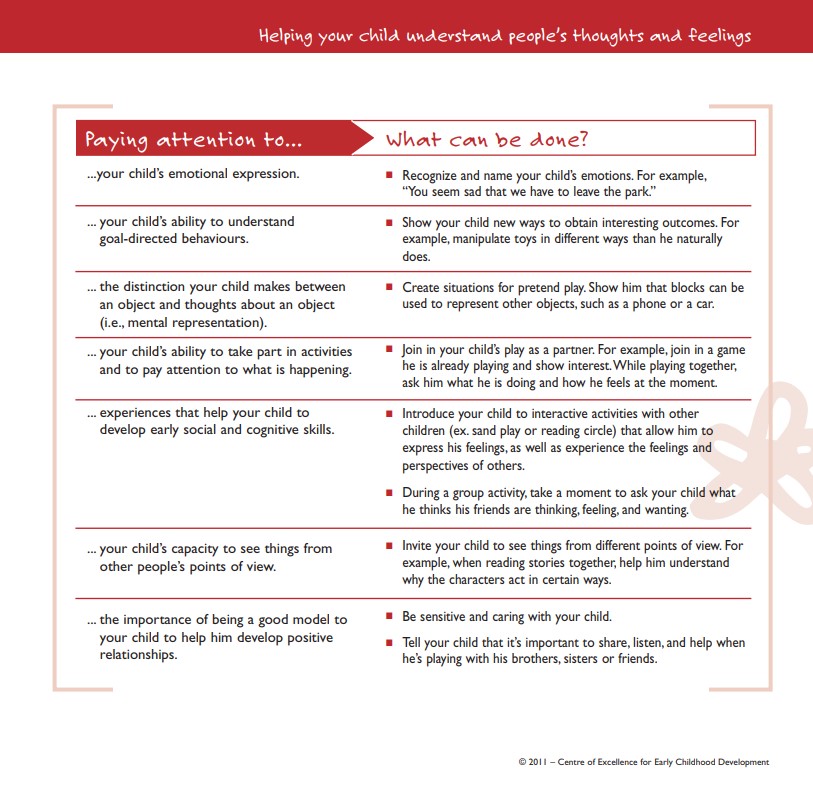
          Social Cognition: Helping Your Child Understand People’s Thoughts and Feelings.

          What do we know?

          • “Social cognition” means being able to understand our own and others’ thoughts, desires, intentions, and feelings.
          • Children begin to develop social skills when they understand how people’s thoughts, desires, intentions, and feelings affect the way they act and behave.
          • Infants are born with an innate preference for social interactions. From birth, they pay the most attention to human faces and voices.
          • In the first months of life, infants are able to smile at people, and respond to others with gestures and facial expressions.
          • By the end of the first year, infants start to share interest and attention in objects with you, and may decide whether or not to try a new activity based on your expression. For example, your infant may not play with a new toy if you appear anxious or worried.
          • Around the age of two, toddlers distinguish a real object from a pretend object (ex. using a block as a telephone).
          • As they grow older, children become able to talk about what they and other people like, want, think or know (around age 3). They also understand that people express different emotions depending on the situation (ex. knowing that an individual is happy when he gets what he wants or sad if he does not).
          • Four-year-old children usually recognize that other people’s thoughts may differ from their own. They no longer believe that everyone knows what they know. This step in their development helps them to understand that their own thoughts do not always reflect reality.
          • Children who are able to control impulsive thoughts and behaviours are better able to develop social cognition.
          • Children who develop social cognition at a young age have the foundations for good social interactions before they start school.
          • School-aged children with a well developed social cognition have a tendency to be better at resolving conflicts with friends, which in turn can lead to more positive relationships with their peers. But equally these children may be better at deception and manipulation.
          • Social and cognitive understanding can have a positive impact on children’s later school success.

          Information
          This Key Message is a publication of the Centre of Excellence for Early Childhood Development (CEECD) and the Strategic Knowledge Cluster on Early Child Development (SKC-ECD). These organizations identify and summarize the best scientific work on early childhood development. They disseminate this knowledge to a variety of audiences in formats and languages adapted to their needs.

          For a more in-depth understanding of Social Cognition, consult our synthesis and Experts’ articles on this topic in the Encyclopedia on Early Childhood Development, available free of charge at www.child-encyclopedia.com.

          Several funders financially support the CEECD and the SKC-ECD, including the Social Sciences and Humanities Research Council of Canada, Université Laval, and private foundations. The views expressed herein do not necessarily represent the official policies of these organizations.

          We are grateful to the Fondation Lucie et André Chagnon, the Margaret & Wallace McCain Family Foundation and the Alberta Centre for Child, Family and Community Research for their financial contributions to produce this Key Message.

          Centre of Excellence for Early Childhood Development
          GRIP-Université de Montréal
          P.O. Box 6128, Succursale Centre-ville
          Montreal, Quebec H3C 3J7
          Telephone: 514.343.6111, extension 2541
          Fax: 514.343.6962
          E-mail: cedje-ceecd@umontreal.ca
          Website: www.excellence-earlychildhood.ca
          In this document, the masculine form is used to simplify the text. No discrimination is intended.

          http://www.child-encyclopedia.com/sites/default/files/docs/coups-oeil/social-cognition-info.pdf

            Request a Complementary Consultation

            NIH Study Reveals Differences in Brain Activity in Children with Anhedonia

            Using fMRI, researchers uncover the neural underpinnings, which could aid development of potential treatments

             • Press Release

            Researchers have identified changes in brain connectivity and brain activity during rest and reward anticipation in children with anhedonia, a condition where people lose interest and pleasure in activities they used to enjoy. The study, by scientists at the National Institute of Mental Health (NIMH), part of the National Institutes of Health, sheds light on brain function associated with anhedonia and helps differentiate anhedonia from other related aspects of psychopathology. The findings appear in the journal JAMA Psychiatry.

            “Understanding the neural mechanisms of anhedonia that are distinguishable from other psychiatric concerns is important for clinicians to develop on-target treatments,” said lead study author Narun Pornpattananangkul, Ph.D., a postdoctoral fellow in the Emotion and Development Branch, part of NIMH’s Division of Intramural Research Programs. “Yet, disentangling shared characteristics from unique neural mechanisms of anhedonia is challenging because it often co-occurs with other psychiatric conditions.”

            To learn more about the neurological underpinnings of anhedonia in children, researchers from the NIMH Division of Intramural Research Programs examined fMRI data collected from more than 2,800 children (9-10 years old) as part of the Adolescent Brain Cognitive Development (ABCD) Study. Some of the children included in the sample were identified as having anhedonia, low mood, anxiety, or attention-deficit/hyperactivity disorder (ADHD). fMRI data were collected while the children were at rest and while they completed tasks assessing reward anticipation and working memory.

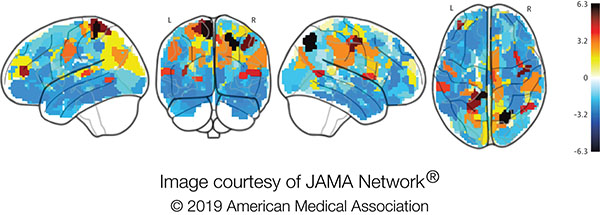
            Analysis of brain connectivity at rest revealed significant differences in children with anhedonia compared to children without anhedonia. Many of these differences were related to the connectivity between the arousal-related cingulo-opercular network and the reward-related ventral striatum area. These findings suggest that children with anhedonia have altered integration of reward and arousal compared to children without anhedonia.

            When the researchers examined brain activity during the tasks, they found that children with anhedonia showed hypoactivation of brain regions involved in integrating reward and arousal during the reward anticipation task — but not the working memory task. This hypoactivation was not seen in children with low mood, anxiety, or ADHD. In fact, children with ADHD showed the opposite pattern: abnormalities in brain activation during the working memory task — but the not the reward anticipation task.

            The study suggests that children with anhedonia have differences in the way their brain integrates reward and arousal and in the way their brain activates when anticipating rewards.

            “We found anhedonia-specific alterations, such that youth with anhedonia, but not youth with low mood, anxiety, or ADHD, showed differences in the way they integrated reward and arousal and also showed diminished activity in reward-anticipation contexts,” said Dr. Pornpattananangkul. “This finding may start to provide the specific neural targets for treating anhedonia in youth.”

            Image showing differences in fMRI activation between children with and without anhedonia during reward anticipation.

            Image showing differences in fMRI activation between children with and without anhedonia during reward anticipation. Credit: JAMA Network

            Reference

            Pornpattananangkul, N., Leibenluft, E., Pine, D., & Stringaris, A. (in press). Mapping anhedonia in youth: Large-scale resting-state network, task-evoked activation and phenotypic demarcation. JAMA Psychiatry.

            IRP Grant

            1ZIAMH002957-02

            About the National Institute of Mental Health (NIMH): The mission of the NIMH is to transform the understanding and treatment of mental illnesses through basic and clinical research, paving the way for prevention, recovery and cure. For more information, visit the NIMH website.

            About the National Institutes of Health (NIH): NIH, the nation’s medical research agency, includes 27 Institutes and Centers and is a component of the U.S. Department of Health and Human Services. NIH is the primary federal agency conducting and supporting basic, clinical, and translational medical research, and is investigating the causes, treatments, and cures for both common and rare diseases. For more information about NIH and its programs, visit the NIH website.

            NIH…Turning Discovery Into Health®

            Source

              Request a Complementary Consultation

              NIH Study Shows Many Preteens Screen Positive for Suicide Risk During ER Visits

              Findings highlight the importance of screening kids as young as 10 for suicide risk in emergency settings

               • Press Release

              A research team found nearly one-third of youth ages 10 to 12 years screened positive for suicide risk in emergency department settings. As part of a larger study on youth suicide risk screening in emergency departments, researchers at the National Institute of Mental Health (NIMH), part of the National Institutes of Health, and collaborators sought to explore how frequently preteen youth ages 10 to 12 screened positive for suicide risk. Notably, 7 percent of the preteens who screened positive for suicide risk were seeking help for physical – not psychiatric – concerns. The study appears online March 11 in Hospital Pediatrics.

              “Typically, suicidal thoughts and behaviors are seen in older teens. It was troubling to see that so many preteens screened positive for suicide risk, and we were alarmed to find that many of them had acted on their suicidal thoughts in the past,” said Lisa Horowitz, Ph.D., M.P.H., a clinical scientist in the NIMH Division of Intramural Research Programs (DIRP) and an author on the paper. “This study shows that children as young as 10 who show up in the emergency department may be thinking about suicide, and that screening all preteens — regardless of their presenting symptoms — may save lives. Otherwise, they may pass through our medical systems undetected.”

              Suicide is a growing public health problem in the U.S. Between 2008 and 2017, there was a substantial rise in the suicide rate for youth ages 10 to 12 and today suicide is the third leading cause of death for this age group.

              Studies have shown that the majority of youth who died by suicide had been seen by a health care provider in the month prior to killing themselves. NIMH has identified hospital emergency departments as a key setting for screening youth for suicide risk given the number of youth who visit the ER every year for mental health concerns and intentional self-harm; however, uncertainty exists about the appropriate age to screen youth.

              In this study, researchers examined the extent to which preteens seen in the emergency department screen positive for suicide risk to inform universal youth suicide risk screening efforts. The 79 preteens in the study came from  three large, urban pediatric hospitals. They were screened for suicide risk using the four-item Ask Suicide-Screening Questions (ASQ) and the 15-item Suicidal Ideation Questionnaire-JR (SIQ-JR). Just over half (53.2 percent) of the preteens in the study came to the hospital because of a physical health concern (e.g., back injury or chest pain) and nearly half (47 percent) came because of a mental health concern (e.g., depression or panic disorder). Answering “yes” to any of the four ASQ items and/or scoring above the SIQ-JR cutoff score was considered a positive screen for suicide risk. Preteens who screened positive on either the ASQ or SIQ-JR received a brief suicide safety assessment by a mental health professional.

              The researchers found that 23 of the 79 (29.1 percent) preteen patients screened positive for suicide risk. More than half (54.1 percent) of the preteens presenting with a psychiatric concern screened positive for suicide risk, and a substantial number (7.1 percent) of the preteens with physical complaints also screened positive for suicide risk. Roughly one in five (17.7 percent) of the preteens, specifically those who visited the emergency department for a psychiatric concern, had previously attempted suicide.

              Of the more than 30 million pediatric emergency visits in 2015, nearly 5.4 million involved youth ages 10-14.

              “Many families use the emergency department as their sole source of health care, which presents a unique opportunity to identify these younger kids who are struggling with suicidal thoughts,” said Maryland Pao, M.D., clinical director of the NIMH DIRP and an author on the paper. “But most preteens seen in the emergency department show up with medical problems and will not disclose their suicidal thoughts unless they are asked directly.”

              If you or someone you know needs immediate help, call the National Suicide Prevention Lifeline at 1-800-273-TALK (8255)Learn more about ways you can help someone who might be at risk for self-harm.

              Reference

              Lanzillo, E.C., Horowitz, L.M., Wharff, E.A., Sheftall, A.H., Pao, M., & Bridge, J.A. (in press). The importance of screening preteens for suicide risk in the emergency department. Hospital Pediatrics.

              Grant

              MH002922

              Clinical Trial

              NCT00623493

              About the National Institute of Mental Health (NIMH): The mission of the NIMH is to transform the understanding and treatment of mental illnesses through basic and clinical research, paving the way for prevention, recovery and cure. For more information, visit the NIMH website.

              About the National Institutes of Health (NIH): NIH, the nation’s medical research agency, includes 27 Institutes and Centers and is a component of the U.S. Department of Health and Human Services. NIH is the primary federal agency conducting and supporting basic, clinical, and translational medical research, and is investigating the causes, treatments, and cures for both common and rare diseases. For more information about NIH and its programs, visit the NIH website.

              NIH…Turning Discovery Into Health®

              Source

                Request a Complementary Consultation