Discipline: How Much Is Enough?

What do we know?

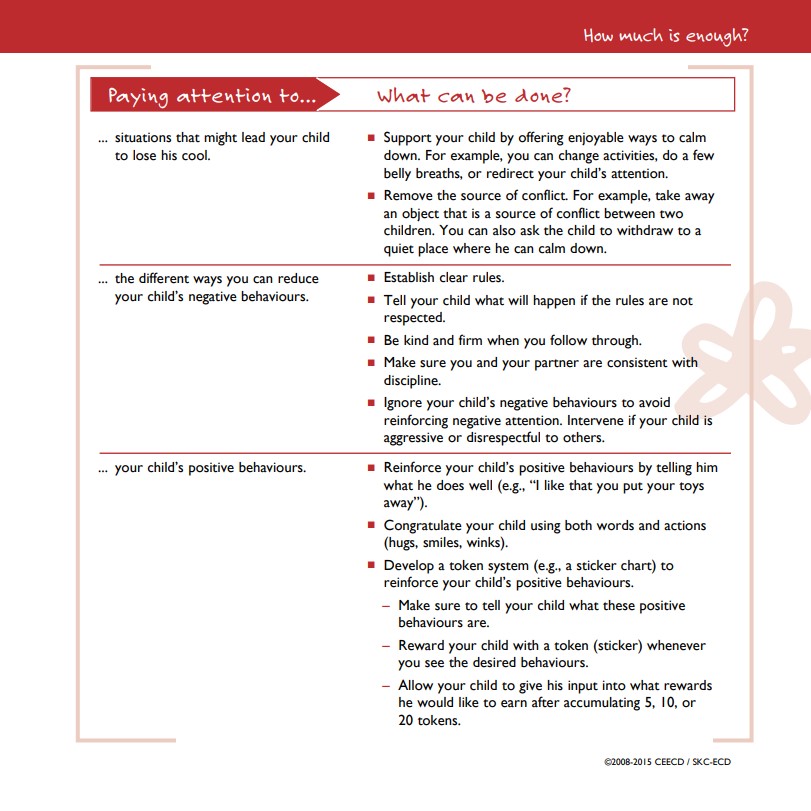
  • Discipline is what you do everyday–it is about teaching and guidance, not punishment.
  • Discipline teaches children what is acceptable and what isn’t.
  • Discipline that combines high levels of warmth and acceptance with firm control helps children to follow instructions, to respect rules, and to be attentive.
  • Parents who establish clear rules and limits encourage the development of positive behaviours and attention in children. They also encourage children to explore their environment while respecting certain limits.
  • Good discipline helps children develop their social skills (empathy, cooperation, problem-solving) and succeed in school.
  • Children have a higher likelihood of developing behavioural problems when parents react with punishments or temper outbursts in face of misbehaviours.
  • Attitudes toward discipline and control vary based on the social and cultural context.
  • Too much parental control may limit children’s ability to make decisions for themselves and to express their needs to parents.
  • In contrast, children who are allowed to do anything they want tend to have trouble distinguishing between what is acceptable and what is not. Poor parental supervision also increases the risk of injuries in young children.

Information
This information sheet is a publication of the Centre of Excellence for Early Childhood Development (CEECD) and the Strategic Knowledge Cluster on Early Child Development (SKC-ECD). These organizations identify and summarize the best scientific work on early childhood development. They disseminate this knowledge to a variety of audiences in formats and languages adapted to their needs.

For a more in-depth understanding of discipline, consult our topics Aggression and Parenting skills in the Encyclopedia on Early Childhood Development, available free of charge at www.child-encyclopedia.com.

Several organizations financially support the CEECD and the SKC-ECD, including the Social Sciences and Humanities Research Council of Canada, Université Laval, and private foundations. The views expressed herein do not necessarily represent the official policies of these organizations.

We are grateful to the Fondation Lucie et André Chagnon for its financial contribution to produce this information sheet and to the Margaret & Wallace McCain Family Foundation for its financial support of this revised edition.

Centre of Excellence for Early Childhood Development
Strategic Knowledge Cluster on Early Child Development

Université de Montréal
3050, Édouard-Montpetit Blvd., GRIP
P.O. Box 6128, succursale Centre-ville
Montreal, Quebec H3C 3J7
Telephone: 514.343.6111, extension 2541
Fax: 514.343.6962
E-mail: cedje-ceecd@umontreal.ca
Websites: www.excellence-earlychildhood.ca and www.skc-ecd.ca
In this document, the masculine form is used merely to simplify the text. No discrimination is intended.

http://www.child-encyclopedia.com/sites/default/files/docs/coups-oeil/discipline-info.pdf

    Request a Complementary Consultation

    About Childhood Grief

    The death of a family member, friend or other significant person is a lifelong loss for children. It is normal for children to miss the person who died and to experience grief that might come and go with different levels of intensity for some time after the death. It can be challenging to parents and caregivers to know what to do for, what to say to and how to help children who are obviously hurting. Here are a few suggestions about how to be helpful to a grieving child based on research and practice among children’s grief support professionals and volunteers. It is important to note that grief reactions in children are varied, wide ranging and unique to each individual. The following suggestions will help guide you as you seek to be provide understanding and compassion to children living with grief.

    Grief is a normal reaction for children to the death of someone significant. When children experience the death of a person who has played a significant role in their life, it is normal for children to struggle, whether the relationship with that person was caring and loving, or contentious and difficult. The absence of a person takes time to fully accept and even then, children may continue to miss them in their own special way. In truth, children never “get over” a person’s death, but they can learn to live with the reality. Grief is not a problem we are trying to fix for a child; it is an experience they are living. Mood changes or feelings of grief, even several years out from the event, are a common part of adapting to life without someone and to the changes that come with that person’s death. Children need adults to be patient with them as they adjust to these changes.

    Children need to know the truth. Most parents and caregivers would agree that they would prefer that their children not have to deal with the difficult truths that might accompany a death. So, quite often we avoid words like “dead” or “die,” or we shade over the truth about how a person died in a desire to protect children. Unfortunately, in doing so, we often create other problems. Although it may be challenging to share the truth about how someone died, honest answers build trust, help provide understanding and allow children to feel comfortable approaching us with questions because they know they can trust us to tell them the truth. Children know more than we think they do and by not telling the truth, we risk leaving children to process complicated information on their own, rather than with the loving adults in their lives.

    Each child’s grief is as unique to him or her as was their relationship with the deceased. Because of this, the way children experience and express their grief will vary for each person. Some children have a need to talk about the person who died and their feelings about it; others might not talk about the person at all; and even others, might express their grief through art, play, music or writing. In whatever way children might experience and respond to their grief, these expressions are how they are adapting to life without the physical presence of that person and adjusting to one of memories. It is important not to assume what children might be feeling about a person’s death. Reactions vary from sadness, anger, fear, guilt and even relief. It is important to listen to children, meet them on their terms and come to understand their unique grief reactions.

    Grieving children often feel alone and misunderstood. Many well-meaning adults avoid talking about the deceased person in fear that doing so will exacerbate the grief children are experiencing. In doing so, children might feel as though talking about or even expressing their grief is not acceptable. Also, many children feel like they are the only person who has experienced the death of someone in their life, even though there might be other friends experiencing similar circumstances. It is helpful to children when the adults in their lives provide opportunities to acknowledge the grief everyone is feeling. It is also helpful when children are able to gather with peers grieving similar situations. When children feel understood by family and friends and when they have the opportunity to express their grief in their own unique way, they feel less alone and, in turn, fare better than they would otherwise.

    Children will experience grief over the death of significant people at different times throughout their lives. Many times, intense feelings of grief will last longer and come more often than we think they should. In time, as children have opportunities to express their grief, tell their stories, share their memories and process what this death means to them, they might find the intense feelings come less often. But, grief is a lifelong journey and children often experience their grief on different levels and at different times throughout their lives. When a child gets their driver’s license, scores a touchdown, goes to prom or graduates from high school, they might revisit their grief in a very intense way. This extends into adulthood as well, when they have children of their own, or get married. Grief has no time limit. Allowing children to share openly about feelings can help to normalize this experience and help them find ways to deal with these powerful feelings that will come and go…and come back again throughout their lives.

    Grieving children often experience personal growth as a result of their loss. Personal growth is often a by-product of going through the grief. It is important to note that personal growth does not diminish the sense of loss or grief a person feels, nor does it imply that someone’s death was a positive experience. Yet, many children have reported that they are more compassionate toward others, value relationships with friends and family on a new level or experience a greater sense of appreciation for life after the death of someone.

    Grieving children feel less alone when they are with other children who have experienced the death of a significant person and when they have loving, consistent adults in their lives. Greater than any education, information or advice we can give to children who are grieving is to allow children who are grieving to connect with other children going through a similar experience. When children have the opportunity to interact with one another, they feel less alone. It is also important for children to have adults in their lives who provide a safe environment that is consistent, teaches resilience and encourages accountability, while allowing children the freedom to express their grief. Research has shown that one of the top indicators of how well children will do after the death of a significant person in their life is directly related to the type of relationship they have with the surviving adult(s) in their lives and how well these adults are able to cope with their own grief.

    Knowledge is Power. You do not have to be alone as the parent or caregiver of a grieving child. There are many resources available via the internet and in the form of grief support for your child. You can find children’s grief support programs near you at www.ChildrenGrieve.org and you can find encouragement and answers to some of your questions at the following websites:

    www.dougy.org
    www.hellogrief.org
    www.achildingrief.com

    Copyright © 2013 by National Alliance for Grieving Children. All rights reserved. You can quote, link to, re-post or translate this article, in its entirety, as long as you include the author name and a working link back to this website. www.ChildrenGrieve.org

    References
    Silverman, Phyllis R., Madelyn, Kelly (2009) A Parent’s Guide to Raising Grieving Children. New York, NY: Oxford University Press.
    Worden, William J. (1996) Children and Grief: When a Parent Dies. New York, NY: Guilford Press.
    Schuurman, Donna (2003) Never the Same: Coming to Terms with the Death of a Parent. New York, NY: St. Martin’s Press.
    Emswiler, Mary Ann, Emswiler, James P. (2000) Guiding Your Child through Grief. New York, NY: Bantam Books.
    Tedeschi, Richard, Calhoun, Lawrence G. (1999) Facilitating Post Traumatic Growth. Mahwah, NJ: Lawrence Erlbaum Associates, Inc.
    Kubler-Ross, Elisabeth (1969) On Death and Dying. New York, NY: Scribner.

    https://childrengrieve.org/resources/about-childhood-grief

      Request a Complementary Consultation

      Laughter is the Best Medicine: The Health Benefits of Humor & Laughter

      Authors: Lawrence Robinson, Melinda Smith, M.A., and Jeanne Segal, Ph.D. Last updated: November 2018.
      Helpguide.org

      Sure, it’s fun to share a good laugh. But did you know it can actually improve your health? It’s true: laughter is strong medicine. It draws people together in ways that trigger healthy physical and emotional changes in the body. Laughter strengthens your immune system, boosts mood, diminishes pain, and protects you from the damaging effects of stress. As children, we used to laugh hundreds of times a day, but as adults, life tends to be more serious and laughter more infrequent. But by seeking out more opportunities for humor and laughter, you can improve your emotional health, strengthen your relationships, find greater happiness—and even add years to your life.

      Why is laughter the sweetest medicine for the mind and body?

      Laughter is a powerful antidote to stress, pain, and conflict. Nothing works faster or more dependably to bring your mind and body back into balance than a good laugh. Humor lightens your burdens, inspires hope, connects you to others, and keeps you grounded, focused, and alert. It also helps you release anger and forgive sooner.

      With so much power to heal and renew, the ability to laugh easily and frequently is a tremendous resource for surmounting problems, enhancing your relationships, and supporting both physical and emotional health. Best of all, this priceless medicine is fun, free, and easy to use.

      Laughter is good for your health

      Laughter relaxes the whole body. A good, hearty laugh relieves physical tension and stress, leaving your muscles relaxed for up to 45 minutes after.

      Laughter boosts the immune system. Laughter decreases stress hormones and increases immune cells and infection-fighting antibodies, thus improving your resistance to disease.

      Laughter triggers the release of endorphins, the body’s natural feel-good chemicals. Endorphins promote an overall sense of well-being and can even temporarily relieve pain.

      Laughter protects the heart. Laughter improves the function of blood vessels and increases blood flow, which can help protect you against a heart attack and other cardiovascular problems.

      Laughter burns calories. OK, so it’s no replacement for going to the gym, but one study found that laughing for 10 to 15 minutes a day can burn approximately 40 calories—which could be enough to lose three or four pounds over the course of a year.

      Laughter lightens anger’s heavy load. Nothing diffuses anger and conflict faster than a shared laugh. Looking at the funny side can put problems into perspective and enable you to move on from confrontations without holding onto bitterness or resentment.

      Laughter may even help you to live longer. A study in Norway found that people with a strong sense of humor outlived those who don’t laugh as much. The difference was particularly notable for those battling cancer.

      Physical health benefits of laughter:

      Boosts immunity Lowers stress hormones Decreases pain Relaxes your muscles Prevents heart disease

      Mental health benefits of laughter:

      Adds joy and zest to life Eases anxiety and tension Relieves stress Improves mood Strengthens resilience

      Social benefits of laughter:

      Laughter helps you stay mentally healthy

      Laughter makes you feel good. And this positive feeling remains with you even after the laughter subsides. Humor helps you keep a positive, optimistic outlook through difficult situations, disappointments, and loss.

      More than just a respite from sadness and pain, laughter gives you the courage and strength to find new sources of meaning and hope. Even in the most difficult of times, a laugh–or even simply a smile–can go a long way toward making you feel better. And laughter really is contagious—just hearing laughter primes your brain and readies you to smile and join in the fun.

      The link between laughter and mental health

      Laughter stops distressing emotions. You can’t feel anxious, angry, or sad when you’re laughing.

      Laughter helps you relax and recharge. It reduces stress and increases energy, enabling you to stay focused and accomplish more.

      Laughter shifts perspective, allowing you to see situations in a more realistic, less threatening light. A humorous perspective creates psychological distance, which can help you avoid feeling overwhelmed and diffuse conflict.

      Laughter draws you closer to others, which can have a profound effect on all aspects of your mental and emotional health.

      Laughter brings people together and strengthens relationships

      There’s a good reason why TV sitcoms use laugh tracks: laughter is contagious. You’re many times more likely to laugh around other people than when you’re alone. And the more laughter you bring into your own life, the happier you and those around you will feel.

      Sharing humor is half the fun—in fact, most laughter doesn’t come from hearing jokes, but
      rather simply from spending time with friends and family. And it’s this social aspect that plays such an important role in the health benefits of laughter. You can’t enjoy a laugh with other people unless you take the time to really engage with them. When you care about someone enough to switch off your phone and really connect face to face, you’re engaging in a process that rebalances the nervous system and puts the brakes on defensive stress responses like “fight or flight.” And if you share a laugh as well, you’ll both feel happier, more positive, and more relaxed—even if you’re unable to alter a stressful situation.

      How laughing together can strengthen relationships

      Shared laughter is one of the most effective tools for keeping relationships fresh and exciting. All emotional sharing builds strong and lasting relationship bonds, but sharing laughter also adds joy, vitality, and resilience. And humor is a powerful and effective way to heal resentments, disagreements, and hurts. Laughter unites people during difficult times.

      Humor and playful communication strengthen our relationships by triggering positive feelings and fostering emotional connection. When we laugh with one another, a positive bond is created. This bond acts as a strong buffer against stress, disagreements, and disappointment. Humor and laughter in relationships allows you to:

      Be more spontaneous. Humor gets you out of your head and away from your troubles. Let go of defensiveness. Laughter helps you forget resentments, judgments, criticisms, and doubts.

      Release inhibitions. Your fear of holding back is pushed aside.

      Express your true feelings. Deeply felt emotions are allowed to rise to the surface.

      Use humor to resolve disagreements and tension in your relationship

      Laughter is an especially powerful tool for managing conflict and reducing tension when emotions are running high. Whether with romantic partners, friends and family, or coworkers, you can learn to use humor to smooth over disagreements, lower everyone’s stress level, and communicate in a way that builds up your relationships rather than breaking them down.

      How to bring more laughter into your life

      Laughter is your birthright, a natural part of life that is innate and inborn. Infants begin smiling during the first weeks of life and laugh out loud within months of being born. Even if you did not grow up in a household where laughter was a common sound, you can learn to laugh at any stage of life.

      Begin by setting aside special times to seek out humor and laughter, as you might with exercising, and build from there. Eventually, you’ll want to incorporate humor and laughter into the fabric of your life, finding it naturally in everything.

      Here are some ways to start:

      Smile. Smiling is the beginning of laughter, and like laughter, it’s contagious. When you look at someone or see something even mildly pleasing, practice smiling. Instead of looking down at your phone, look up and smile at people you pass in the street, the person serving you a morning coffee, or the co-workers you share an elevator with. Notice the effect on others.

      Count your blessings. Literally make a list. The simple act of considering the positive aspects of your life will distance you from negative thoughts that block humor and laughter. When you’re in a state of sadness, you have further to travel to reach humor and laughter.

      When you hear laughter, move toward it. Sometimes humor and laughter are private, a shared joke among a small group, but usually not. More often, people are very happy to share something funny because it gives them an opportunity to laugh again and feed off the humor you find in it. When you hear laughter, seek it out and ask, “What’s funny?”

      Spend time with fun, playful people. These are people who laugh easily–both at themselves and at life’s absurdities–and who routinely find the humor in everyday events. Their playful point of view and laughter are contagious. Even if you don’t consider yourself a lighthearted, humorous person, you can still seek out people who like to laugh and make others laugh. Every comedian appreciates an audience.

      Bring humor into conversations. Ask people, “What’s the funniest thing that happened to you today? This week? In your life?”

      Simulated laughter

      So, what if you really can’t “find the funny?” Believe it or not, it’s possible to laugh without experiencing a funny event—and simulated laughter can be just as beneficial as the real thing. It can even make exercise more fun and productive. A Georgia State University study found that incorporating bouts of simulated laughter into an exercise program helped improve older adults’ mental health as well as their aerobic endurance. Plus, hearing others laugh, even for no apparent reason, can often trigger genuine laughter.

      To add simulated laughter into your own life, search for laugh yoga or laugh therapy groups. Or you can start simply by laughing at other people’s jokes, even if you don’t find them

      funny. Both you and the other person will feel good, it will draw you closer together, and who knows, it may even lead to some spontaneous laughter.

      Creating opportunities to laugh;

      Watch a funny movie, TV show, or YouTube video Invite friends or co-workers out to a comedy club Read the funny pages Seek out funny people Share a good joke or a funny story Check out your bookstore’s humor section Host game night with friends Play with a pet Go to a “laughter yoga” class Goof around with children Do something silly Make time for fun activities (e.g. bowling, miniature golfing, karaoke)

      Tips for developing your sense of humor

      An essential ingredient for developing your sense of humor is to learn not to take yourself too seriously and laugh at your own mistakes and foibles. As much as we’d like to believe otherwise, we all do foolish things from time to time. Instead of feeling embarrassed or defensive, embrace your imperfections. While some events in life are clearly sad and not opportunities for laughter, most don’t carry an overwhelming sense of either sadness or delight. They fall into the gray zone of ordinary life—giving you the choice to laugh or not. So choose to laugh whenever you can.

      How to develop your sense of humor

      Laugh at yourself. Share your embarrassing moments. The best way to take yourself less seriously is to talk about times when you took yourself too seriously.

      Attempt to laugh at situations rather than bemoan them. Look for the humor in a bad situation, and uncover the irony and absurdity of life. When something negative happens, try to make it a humorous anecdote that will make others laugh.

      Surround yourself with reminders to lighten up. Keep a toy on your desk or in your car. Put up a funny poster in your office. Choose a computer screensaver that makes you laugh. Frame photos of you and your family or friends having fun.

      Remember funny things that happen. If something amusing happens or you hear a joke or funny story you really like, write it down or tell it to someone to help you remember it.

      Don’t dwell on the negative. Try to avoid negative people and don’t dwell on news stories, entertainment, or conversations that make you sad or unhappy. Many things in life are beyond your control—particularly the behavior of other people. While you might view carrying the weight of the world on your shoulders as admirable, in the long run it’s unrealistic and unhealthy.

      Find your inner child. Pay attention to children and try to emulate them—after all, they are the experts on playing, taking life lightly, and laughing at ordinary things.

      Deal with stress. Stress can be a major impediment to humor and laughter, so it’s important to keep your stress levels in check. One great technique to relieve stress in the moment is to draw upon a favorite memory that always makes you smile—something your kids did, for example, or something funny a friend told you.

      Don’t go a day without laughing. Think of it like exercise or breakfast and make a conscious effort to find something each day that makes you laugh. Set aside 10 to 15 minutes and do something that amuses you. The more you get used to laughing each day, the less effort you’ll have to make.

      Using humor to overcome challenges and enhance your life

      The ability to laugh, play, and have fun not only makes life more enjoyable but also helps you solve problems, connect with others, and think more creatively. People who incorporate humor and play into their daily lives find that it renews them and all of their relationships.

      Life brings challenges that can either get the best of you or become playthings for your imagination. When you “become the problem” and take yourself too seriously, it can be hard to think outside the box and find new solutions. But when you play with the problem, you can often transform it into an opportunity for creative learning.

      Playing with problems seems to come naturally to children. When they are confused or afraid, they make their problems into a game, giving them a sense of control and an opportunity to experiment with new solutions. Interacting with others in playful ways helps you retain this creative ability.


        Request a Complementary Consultation

        Bench-to-Bedside: NIMH Research Leading to Brexanolone, First-Ever Drug Specifically for Postpartum Depression

        Approximately 1 in 9 women in the United States experiences symptoms of postpartum depression, according to the Centers for Disease Control and Prevention. Now, the Food and Drug Administration (FDA) has approved brexanolone, an analog of the endogenous human hormone allopregnanolone and the first drug specifically designed to treat postpartum depression.

        Some psychiatric drugs owe their discovery to chance — serendipitous observations of clinical benefit — or a process of incremental improvement based on drugs previously discovered by chance. Not so with brexanolone, which has a truly novel mechanism of action and was developed by design, thanks to a series of basic and translational neuroscience studies. FDA approval represents the final phase of a bench-to-bedside journey for this drug — a journey that began in the NIMH Intramural Research Program (IRP).

        In the 1980s, NIMH IRP researchers discovered that metabolites (products formed when the body breaks down or “metabolizes” other substances) of the steroid hormones progesterone and deoxycorticosterone bound to and acted upon receptors for gamma-aminobutyric acid (GABA) — a major inhibitory neurotransmitter in the brain. These steroids were found to amplify GABA-activated chloride ion currents, thereby impacting the excitability of neurons.

        This finding led to a series of studies, completed by researchers in the NIMH IRP and by researchers at institutions funded by NIMH, that clarified how these metabolites fluctuate during times of stress and during the estrous cycle in rats and the menstrual cycle in humans. Research indicated that the concentration of one of these metabolites (allopregnanolone) increases during pregnancy, but then drops after birth. In some women, this drop triggers the development of depression and anxiety.

        A biopharmaceutical company utilized these basic research findings to develop brexanolone, a drug that can be used to treat postpartum depression by restoring levels of this metabolite. Successful clinical trials have led to FDA approval of an injectable version of this drug.

        Want to learn more about this story? NIMH experts are available to provide information on postpartum depression and the importance of, and the science underlying, brexanolone.

        Who:

        For interviews, photos, or additional background information, please contact the NIMH Press Office at 301-443-4536 or NIMHpress@nih.gov.

        About the National Institute of Mental Health (NIMH): The mission of the NIMH is to transform the understanding and treatment of mental illnesses through basic and clinical research, paving the way for prevention, recovery and cure. For more information, visit the NIMH website.

        About the National Institutes of Health (NIH): NIH, the nation’s medical research agency, includes 27 Institutes and Centers and is a component of the U.S. Department of Health and Human Services. NIH is the primary federal agency conducting and supporting basic, clinical, and translational medical research, and is investigating the causes, treatments, and cures for both common and rare diseases. For more information about NIH and its programs, visit the NIH website.

        NIH…Turning Discovery Into Health®

        Source

          Request a Complementary Consultation

          When Therapy Doesn’t Work

          When Therapy Doesn’t Work

          What to do next


          Joel L. Young, M.D.

          For many people, therapy is a treatment of last resort. A depressed person, for instance, might delay therapy for months or even years, only to give in when his symptoms become so terrible that anything seems preferable to living another day with depression.  Because therapy patients often view therapy as a panacea—and one which they’ll only try when life gets impossible—the disappointment you feel when therapy doesn’t work can be deep, cutting, and profoundly demoralizing.

          Mental illness is just like any other health condition, though. Whether it’s difficulty coping with stress or something more serious, such as post-traumatic stress disorder, the first treatment doesn’t always work. If you had heart disease, you wouldn’t throw up your hands and give up if your first medication didn’t yield results, so don’t do the same with therapy! If therapy has failed you, you still have plenty of options for feeling better.

          Ask Your Therapist About Next Steps

          If therapy isn’t working, the first person you should talk to is your therapist. She may opt to change her approach to treatment, pursue more “homework” options for you, or even refer you to another therapist.


          Be sure to ask the following questions:

          • How long should it take for me to see results?
          • What treatment method are we using, and is it too early to try a different approach?
          • Is there anything I can do to increase the efficacy of therapy?
          • Could medication help? What about lifestyle changes?

          Pursue Lifestyle Changes

          Therapy is just one step in your treatment journey, not the whole journey. One of the greatest benefits of therapy is that your therapist can give you the confidence and strength you need to pursue lifestyle treatments. A good therapist can also recommend changes you can make that might improve your prognosis. Every person is different, and every mental health condition demands slightly different treatment. Generally speaking, though, the following lifestyle changes can often help you combat mental illnesses:

          • Developing a regular schedule and taking time each day to plan your day. Remember, time is exactly like money, and by budgeting your time, you may find you have more of it—not to mention less stress.
          • Take steps to ensure your lifestyle and environment are healthy. If you are in an abusive relationship, leave. If conflict with loved ones is an ongoing problem, work to resolve these conflicts.
          • Eat a balanced, healthy diet rich in lean proteins, fruits, and veggies.
          • Get at least 150 minutes of cardiovascular activity each week.
          • Commit to a regular sleep schedule, getting up and going to bed at the same time each night. Aim for seven to eight hours of sleep.
          • Start meditating. If meditation is not your style, try another activity that forces you to slow down and focus on your breathing, such as yoga or mindfulness-based cognitive therapy.

          Do Your Homework

          Therapy isn’t brain magic. There’s nothing your therapist can say that will mysteriously re-scramble things in your brain, immediately making your life better. Instead, therapy is hard work. Just as you’ll never learn algebra if you don’t do your math homework, you’ll never learn to better manage your emotions and life if you don’t do your therapy homework. By following your therapist’s assignments, you enable yourself to adopt new coping mechanisms and move beyond the struggles of the past.

          But what if your therapist doesn’t give you homework? Homework doesn’t have to be specific or involve paper. Instead, it’s simply a matter of doing the things your therapist suggests with an open mind. If he asks you to focus on saying no less, give it a shot before rejecting it out of hand. And if your therapist doesn’t give you homework, it’s time to start asking for some—or begin working with a therapist who is a bit more proactive.


          Try a New Therapist

          The single best predictor of whether therapy will work is whether you and your therapist is a good fit. A therapist who accepts your values, understands your emotions, and who makes you feel accepted and heard is key to therapy. If your therapist isn’t offering you this, it’s time to try someone else.

          What if you like your therapist but therapy’s just not going where you want it? It’s not enough to like your therapist, and there’s huge differences in competence from therapist to therapist. If therapy’s not working, consider whether your therapist is the right one for you. If your therapist hasn’t done at least the following, it’s time to move on:

          article continues after advertisement

          • Talked with you about treatment options and advised on what you can do to increase the effectiveness of therapy.
          • Set specific treatment goals and given you a timetable for when you can see results
          • Talked to you about medication for your mental health condition.
          • Given you a diagnosis or a clear picture of what you’re in therapy to work on.
          • Given you clear, specific recommendations for homework and other activities you can do to build upon what you’re learning in therapy.


          Talk to Your Doctor

          Research suggests that, for many mental health conditions, combining therapy with medication is the single most effective way to see results. If therapy’s not working, it’s time to consider taking medication. But medication is not the only thing your doctor can help you with. Health problems can interfere with your progress, and some physical health problems masquerade as mental health problems. The sluggishness some people experience with hypothyroidism, for example, can mimic common symptoms of depression. It could be that you’re struggling with an easily treated health problem, so ask for blood work and give your doctor a specific, detailed list of your symptoms and health history.

          It can be deeply frustrating when therapy doesn’t work, but this is just the beginning of the journey, not the end. If you’re willing to research your condition, be a good advocate for yourself, and keep trying until something works, you can feel better sooner than you expect.

            Request a Complementary Consultation

            THE MOST EFFECTIVE PARENTING STYLE FOR DISCIPLINE THAT WORKS 

            Discipline Basics
            Often parents wonder how they can create an environment in their homes and in their relationships with their children that will nurture their children’s ability to meet the challenges they will confront as they grow and move out into the world. The kind of discipline you use can have a big influence on this.
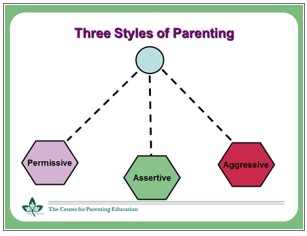
            There are three main parenting styles that are most commonly used.


            • What distinguishes one from the other is the amount and kind of structure that the family has in place and the kind of discipline it imposes.
            • These different approaches exist on the arc of a pendulum from the loosest organization to the most rigid.
            • Most families are blends of all three strategies, usually with one approach being dominant.

            The Three Parenting Styles
            These three styles are called the Permissive style, the Aggressive style, and the Assertive style.

            Let’s take a look at three different ways a parent might handle the same situation: an eight-year-old leaves his things all over the family room floor even after being asked numerous times to pick up after himself.

            Permissive Style
            “Oh Honey, I see your stuff is still left out. I guess you were too busy to clean up. I’ll clean-up for you so you can find everything next time you want to play with them.”

            This parent demonstrates what is called the Permissive style that relies most heavily on the nurture role, but without offering enough structure.

            This parent does not hold the child accountable for cleaning up his items and does not show herself to be the authority figure in the home.

            Clues that you are using the Permissive Style
            • Evading discipline issues
            • Begging for cooperation
            • Acting flustered
            • Being unclear or indirect in your requests
            • Being a martyr versus asking for what you need
            • Worrying about being “liked” by your child
            • Fearing that you may upset your child
            • Blaming yourself and taking all the responsibility when problems arise
            • Being inconsistent with expectations

            Results of Using the Permissive Style
            • Your child does not learn to respect you.
            • He is not held accountable for his behavior.
            • Proper limits are not set.
            • Your child has too much power in the house.
            • He does not learn to be responsible to fulfill obligations.
            • He is not encouraged to learn the tasks of everyday living that he will need as an adult.

            As a result, your child will not build healthy self-esteem. It also damages the relationship between you and your child.

            When you use a permissive style of parenting, you do not show yourself to be “in-charge,” and as a result, your child will be less likely to turn to you for guidance in other situations in his life.

            Aggressive Style
            “I’m sick and tired of seeing your things all over the room. Why are you such an irresponsible slob? That’s it for you – you are grounded for a week and I’m throwing out all your things.”

            This parent demonstrates the other end of the discipline pendulum, which is called the Aggressive style of parenting. It relies most heavily on the structure role, while not including enough caring and nurture.

            A parent using this style refuses to listen to the child’s point of view at all and is typically harsh, angry, and cold.

            Clues that you are using the Aggressive Style
            • Having many power struggles
            • Accusing your child of having bad intentions
            • Discrediting your child’s ideas
            • Tricking, teasing, humiliating your child
            • Doling out harsh punishments
            • Rigidly enforcing rules
            • Withholding information about expectations
            • Having a litany of strict rules

            Results of Using the Aggressive Style
            • The self-esteem of your child is damaged because he does not feel understood or supported.
            • The parent-child relationship is weakened as your child would not feel that you are someone he could turn to if he had a problem.
            • Children from these families often become either overly submissive or rebellious.

            Assertive Style
            “Jon, I see your games are still not put away as I asked you to do. It is really bothering me that I can’t count on you to take care of your things and I can’t stand seeing the family room be such a mess. We need to come up with a plan for you to put your things away. Until we can agree upon a plan, there are no electronics for you.”
            This parent demonstrates the third style of discipline which falls in between the two extremes and is called the Assertive approach to parenting.
            Parents using this approach are willing to listen and yet still hold firm so that the parent’s and the child’s needs are both basically met.
            When setting limits, the parent does not get sidetracked, can provide choices, and allows the child an opportunity to participate in finding a solution.

            Clues that you are using the Assertive Style
            • Persisting until your requests are followed
            • Listening to your child’s point of view
            • Giving brief reasons
            • Revealing honest feelings
            • Politely refusing
            • Empathizing
            • Setting reasonable consequences
            • Accepting your need to be “in-charge”
            • Not blaming your child
            • Making clear, direct requests
            • Having rules that are flexible

            Results of Using the Assertive Style
            This style:
            • Is most successful because it uses a healthy balance of both nurture and structure.
            • Raises your child’s self-esteem because you communicate that your child is lovable and loved and worthy of respect.
            Communicates that your child is capable of meeting the demands that life places on him – he can tolerate some frustration and he can contribute to solving the problems he encounters.

            • Builds a strong parent-child relationship, as your child realizes that he can depend on you to both understand his struggles and provide guidance and support. When you use an Assertive style of parenting, your child is more likely to come to you for direction in the future as issues arise in his life.

            Benefits to Children
            They:
            • See you as a source of support.
            • Have a sense of safety because rules are in place.
            • Feel lovable and worthy of being cared for.
            • Feel listened to and understood.
            • Develop basic feelings of trust in relationships.
            • Learn to be kind to other people.
            • Consider another person’s point of view.
            • Learn to tolerate frustration and disappointment.
            • Learn to be responsible and to make decisions.
            • Learn that they are capable of doing things.
            • Become more independent.
            • Learn they can tackle difficult situations.

            Tips for Using an Assertive Parenting Style
            Your children see you modeling assertiveness as you take care of and respect yourself and others. To use an Assertive approach:

            LISTEN
            When your children talk about things that may bother them, acknowledge their feelings and let them know you have heard them.
            Be respectful
            When you discipline, you can set limits without blaming or shaming your children.
            Model
            Exhibit the behavior you would like your children to exhibit.
            Give children choices
            When possible give your kids opportunities to make decisions on issues that effect them. This is respectful, encourages independence, and shows you have trust in them.
            Your children are more likely to cooperate when they have had a say in the decision-making.
            Send clear messages about your expectations
            Establish clear rules
            Know that it is in your children’s best interest to have clear rules that are consistently enforced with persistence, love, and warmth.
            Use praise
            Praise your children for positive behavior that you would like to see repeated: “Catch them being good.”
            Plan ahead
            To avoid problems, anticipate situations that might be difficult for your children. Prepare them for such times.
            Follow through with discipline and consequences
            Be consistent
            Also allow for sufficient flexibility to accommodate specific situations and your unique child.


            Summary of Three Parenting Styles

            Too Much Nurture (Permissive Style) Balance of Nurture/Structure (Assertive Style) Too Much Structure (Aggressive Style)
            Evades Persists Blows up
            Begs Listens to other’s point Has power struggles
            “Makes do” Gives brief reasons Accuses
            Acts flustered Reveals honest feelings Endlessly argues
            Is unclear Politely refuses Discredits other’s ideas
            Is a martyr Empathizes Tricks, teases, humiliates
            Worries about popularity Carries out reasonable consequences Gives harsh punishment
            Fears upsetting the child Accepts need to assert Rigid enforcement of rules
            Blames self No blame Blames child
            Inconsistent information about expectations Clear, direct requests Withholds information about expectations
            Chaos in physical and emotional environment Rules are flexible and change as children grow Litany of strict rules

              Request a Complementary Consultation

              Why Taking a Fishing Trip Is Good for Your Mental Health

              BY ANDREA ROMANO

              If you’re feeling down or burnt out, it might be time to get back into nature.

              According to Niels Eék, psychologist and co-founder of mental wellbeing and self-development platform Remente, spending time in nature may be the key to good mental health.

              “Several researchers have looked into the health benefits connected to spending time out in nature. One study specifically, which was recently published in BioScience Journal, found that daily exposure to nature can, among other things, help reduce feelings of stress and even improve your self-esteem, for up to seven hours. Reconnecting with nature can also help you become more mindful and present in the moment,” Eék said in a statement.

              Moreover, a study from the University of Michigan suggests that being in nature not only improves your mood for the time, but also has positive long-term effects when it comes to depression and memory, as well as decreasing the risk of certain cancers and high blood pressure.

              So what should you do to boost your mental health effectively in nature? Well, there is always camping, biking and hiking, but some experts believe the best way to take care of your mind is to go on a fishing trip.

              An Australian survey funded by the Recreational Fishing Initiatives Scheme reports relaxation and stress relief are the main benefits people get from recreational fishing, according to reps for Fishbrain, a mobile app and social network for people who love to fish.

              The free app has attracted millions of users who have discovered fishing as their newfound self-care hobby. The app uses an interactive map to allow users to find the best places to fish, as well as record their catches, plan trips, share tips and techniques, and purchase the latest gear.

              “Fishing is one of the most popular sports in the world and one of only a few truly global hobbies,” Johan Attby, CEO and founder of Fishbrain, said in a statement “With data and sophisticated technology at its core, and an engaged community as its heart, Fishbrain has become a social network that both inspires and equips users across the globe to have more fun by fishing smarter, not harder.”

              So it’s easier than ever to go fishing, even if you’re a newbie, without the added stress of not catching anything.

              Fishbrain’s users can attest to the mental health benefits of fishing. “Fishing has become critical to my mental health. My job as a sales/production manager can be quite stressful at times, and nothing relieves stress and centers me like fishing,” said Gabe Beaudry of Central Oregon.

              “Going fishing outdoors increases your vitamin D, which helps regulate the amount of calcium and phosphate in your body, keeping your bones and teeth healthy. It boosts your immune system and has been linked to fighting depression,” added Chasten Whitfield of Cortez, Florida.

                Request a Complementary Consultation

                Set Your Child Up for Success by Teaching Healthy Boundaries

                As a parent, you may have wondered how best to help your children learn to make positive choices. One way to set your children up for success is to establish strong boundaries in your home.

                It’s essential to begin instructing your children about boundaries between themselves and others very early on in their childhood. A child who grows up in a home where healthy limits are well established will learn to apply such boundaries in his or her own life, thus developing better self-control and the capacity to make positive choices.

                What Does “Boundary” mean?

                A boundary signifies a limit that a person has for themselves. Limits that people set can be physical or emotional boundaries.

                1. Physical boundaries. This limit can be physical and tangible, such as one’s own body parts. This involves explaining to a child that his body belongs only to himself and that nobody else teaches him to develop a sense of his physical self. Explaining, “Daddy’s body belongs to him” and “Your body belongs to you” is a good place to start.

                2. Emotional boundaries. Another type of boundary is more emotional than physical. Teaching children that it’s not okay to say hurtful things to others is an example of an emotional boundary. Teasing would be another way of crossing a person’s emotional boundaries.

                In a sense, boundaries are rules that you live by. Living with boundaries basically means, “I won’t do anything to harm you” and “I expect you not to do anything to harm me, but if you do, I’ll let you know.”

                Teaching Boundaries:
                When you’re raising kids to have healthy boundaries, it’s important to allow your children to have and express their own feelings. This one can be pretty tough as it isn’t unusual for some parents to try to suppress a child’s healthy behavioral expression.
                For example, if a 4-year-old starts crying and stomps her feet, what would you do as a parent? One healthy strategy to ensure your 4-year-old develops healthy boundaries is to help her label her feelings. Say something like, “I see that you’re frustrated that you can’t have the candy right now. Maybe you can have some candy after dinner.” Then, move on with life.

                You helped her to label her emotions. You chose not to punish her or demand that she stop crying or “Straighten up right now.” As a parent, you just showed acceptance of your child’s feelings. Each time you behave this way as a parent, you’re reinforcing your child’s natural sense of self and boundaries.

                Another example is a two or three-year who throws a toy at their sibling. Again, tell your child that it’s okay to have and express angry feelings, but it’s not okay to throw a toy at others. During the episode, show no feelings. When you’re establishing boundaries, it’s time to be diplomatic. Be firm, but not frustrated or angry.

                Simply state, “It’s not okay to throw a toy at your brother. When you throw a toy, you have to sit in a chair,” and say nothing more until the minutes have passed. Have your child sit in a chair for the number of minutes that matches their age (if they’re two years old, they sit for 2 minutes; 3 years old, 3 minutes).

                After the time is up, thank your child for sitting in the chair and go on with your day. Hopefully, your child will not throw a toy again. Instead, he or she will see that you allowed them to have and show feelings without negative consequences, as long as they stayed within your boundary.

                Expect your children to occasionally “test the limit,” or challenge your boundary–this is completely normal. When these testing behaviors occur, think of each situation as an opportunity to show your kids the consequences of crossing the line.

                Sometimes, there will be situations when you find it prudent to explain some boundary situations or “rules” to your child. For example, telling your child that no one but a doctor when Mom or Dad is also present should touch your child where their bathing suit fits is an effective way to teach limits and boundaries related to his or her own body.

                Modeling Boundaries

                Ultimately, the single best way to teach children healthy boundaries is for parents to have healthy boundaries themselves and to model them in the home.

                Showing respect for each person in the house, ensuring everyone has rights to their feelings and appropriate expressions of them, as well as talking openly and honestly about any challenging issues demonstrate healthy boundaries for children.

                From the time your children are born, you’re charged to teach them many things so they’ll grow up to make positive choices in life. Help create happier, healthier lives for your kids by teaching your children about limits and boundaries.

                Parents who ensure their kids grow up learning about limits and boundaries provide a solid foundation for their children’s futures. Apply some of these methods in your home to teach your kids about having and maintaining healthy limits and boundaries, and your kids will thrive.

                  Request a Complementary Consultation

                  Parenting/Child Development Series – 3-5 yrs

                  Preschoolers (3-5 years of age)
                  Developmental Milestones
                  Skills such as naming colors, showing affection, and hopping on one foot are called developmental milestones. Developmental milestones are things most children can do by a certain age. Children reach milestones in how they play, learn, speak, behave, and move (like crawling, walking, or jumping).

                  As children grow into early childhood, their world will begin to open up. They will become more independent and begin to focus more on adults and children outside of the family. They will want to explore and ask about the things around them even more. Their interactions with family and those around them will help to shape their personality and their own ways of thinking and moving. During this stage, children should be able to ride a tricycle, use safety scissors, notice a difference between girls and boys, help to dress and undress themselves, play with other children, recall part of a story, and sing a song.

                  For more details on developmental milestones, warning signs of possible developmental delays, and information on how to help your child’s development, visit the “Learn the Signs. Act Early.” campaign website. http://www.cdc.gov/ncbddd/actearly/index.html

                  Positive Parenting Tips

                  Following are some things you, as a parent, can do to help your preschooler during this time:

                  • Continue to read to your child. Nurture her love for books by taking her to the library or bookstore.
                  • Let your child help with simple chores.
                  • Encourage your child to play with other children. This helps him to learn the value of sharing and friendship.
                  • Be clear and consistent when disciplining your child. Explain and show the behavior that you expect from her. Whenever you tell her no, follow up with what he should be doing instead.
                  • Help your child develop good language skills by speaking to him in complete sentences and using “grown up” words. Help him to use the correct words and phrases.
                  • Help your child through the steps to solve problems when she is upset.
                  • Give your child a limited number of simple choices (for example, deciding what to wear, when to play, and what to eat for snack).

                  Child Safety First
                  As your child becomes more independent and spends more time in the outside world, it is important that you and your
                  child are aware of ways to stay safe. Here are a few tips to protect your child:

                  • Tell your child why it is important to stay out of traffic. Tell him not to play in the street or run after stray balls.
                  • Be cautious when letting your child ride her tricycle. Keep her on the sidewalk and away from the street and always have her wear a helmet.
                  • Check outdoor playground equipment. Make sure there are no loose parts or sharp edges.
                  • Watch your child at all times, especially when he is playing outside.
                  • Be safe in the water. Teach your child to swim, but watch her at all times when she is in or around any body of water (this includes kiddie pools).
                  • Teach your child how to be safe around strangers.
                  • Keep your child in a forward-facing car seat with a harness until he reaches the top height or weight limit allowed by the car seat’s manufacturer. Once your child outgrows the forward-facing car seat with a harness, it will be time for him to travel in a booster seat, but still in the back seat of the vehicle. The National Highway Traffic Safety Administration has information on how to keep your child safe while riding in a vehicle.

                  Healthy Bodies

                  • Eat meals with your child whenever possible. Let your child see you enjoying fruits, vegetables, and whole grains at meals and snacks. Your child should eat and drink only a limited amount of food and beverages that contain added sugars, solid fats, or salt.
                  • Limit screen time for your child to no more than 1 to 2 hours per day of quality programming, at home, school, or child care.
                  • Provide your child with age-appropriate play equipment, like balls and plastic bats, but let your preschooler choose what to play. This makes moving and being active fun for your preschooler.

                  A pdf of this document for reprinting is available free of charge from
                  http://www.cdc.gov/ncbddd/childdevelopment/positiveparenting/preschoolers.html


                  Additional Information:
                  http://www.cdc.gov/childdevelopment
                  1-800-CDC-INFO (800-232-4636) http://www.cdc.gov/info

                    Request a Complementary Consultation

                    Parenting/Child Development Series – 6-8 yrs

                    Middle Childhood (6-8 years of age)
                    Developmental Milestones
                    Middle childhood brings many changes in a child’s life. By this time, children can dress themselves, catch a ball more easily using only their hands, and tie their shoes. Having independence from family becomes more important now. Events such as starting school bring children this age into regular contact with the larger world. Friendships become more and more important. Physical, social, and mental skills develop quickly at this time. This is a critical time for children to develop confidence in all areas of life, such as through friends, schoolwork, and sports.

                    Here is some information on how children develop during middle childhood:

                    Emotional/Social Changes
                    Children in this age group might:

                    • Show more independence from parents and family.
                    • Start to think about the future
                    • Understand more about his or her place in the world.
                    • Pay more attention to friendships and teamwork.
                    • Want to be liked and accepted by friends.

                    Thinking and Learning

                    • Children in this age group might.
                    • Show rapid development of mental skills.
                    • Learn better ways to describe experiences and talk about thoughts and feelings.
                    • Have less focus on one’s self and more concern for others.

                    Positive Parenting Tips
                    Following are some things you, as a parent, can do to help your child during this time:

                    • Show affection for your child. Recognize her accomplishments.
                    • Help your child develop a sense of responsibility—ask him to help with household tasks, such as setting the table.
                    • Talk with your child about school, friends, and things she looks forward to in the future.
                    • Talk with your child about respecting others. Encourage him to help people in need.
                    • Help your child set her own achievable goals—she’ll learn to take pride in herself and rely less on approval or reward from others.
                    • Help your child learn patience by letting others go first or by finishing a task before going out to play. Encourage him to think about possible consequences before acting.
                    • Make clear rules and stick to them, such as how long your child can watch TV or when she has to go to bed. Be clear about what behavior is okay and what is not okay.\
                    • Do fun things together as a family, such as playing games, reading, and going to events in your community. Positive Parenting Tips for Healthy Child Development
                    • Get involved with your child’s school. Meet the teachers and staff and get to understand their learning goals and how you and the school can work together to help your child do well.
                    • Continue reading to your child. As your child learns to read, take turns reading to each other.
                    • Use discipline to guide and protect your child, rather than punishment to make him feel bad about himself. Follow up any discussion about what not to do with a discussion of what to do instead.
                    • Praise your child for good behavior. It’s best to focus praise more on what your child does (“you worked hard to figure this out”) than on traits she can’t change (“you are smart”).
                    • Support your child in taking on new challenges. Encourage her to solve problems, such as a disagreement with another child, on her own.
                    • Encourage your child to join school and community groups, such as a team sports, or to take advantage of volunteer opportunities.

                    Child Safety First
                    More physical ability and more independence can put children at risk for injuries from falls and other accidents. Motor vehicle crashes are the most common cause of death from unintentional injury among children this age.

                    • Protect your child properly in the car. For detailed information, see the American Academy of Pediatrics’ Car Safety Seats: A Guide for Families.
                    • Teach your child to watch out for traffic and how to be safe when walking to school, riding a bike, and playing outside.
                    • Make sure your child understands water safety, and always supervise her when she’s swimming or playing near water.
                    • Supervise your child when he’s engaged in risky activities, such as climbing.
                    • Talk with your child about how to ask for help when she needs it.
                    • Keep potentially harmful household products, tools, equipment, and firearms out of your child’s reach.

                    Healthy Bodies

                    • Parents can help make schools healthier. Work with your child’s school to limit access to foods and drinks with added sugar, solid fat, and salt that can be purchased outside the school lunch program.
                    • Make sure your child has 1 hour or more of physical activity each day.
                    • Limit screen time for your child to no more than 1 to 2 hours per day of quality programming, at home, school, or afterschool care.
                    • Practice healthy eating habits and physical activity early. Encourage active play, and be a role model by eating healthy at family mealtimes and having an active lifestyle.

                    A pdf of this document for reprinting is available free of charge from
                    http://www.cdc.gov/ncbddd/childdevelopment/positiveparenting/middle.html

                    Additional Information:
                    http://www.cdc.gov/childdevelopment
                    1-800-CDC-INFO (800-232-4636) http://www.cdc.gov/info

                      Request a Complementary Consultation